
Quick Summary
- Package delivery apps help delivery teams turn long lists of stops into clear, practical routes for drivers.
- The best apps include route planning, route optimization, live tracking, customer notifications, and basic reporting on delivery performance.
- Using a package delivery app alongside delivery management software gives planners one place to schedule runs, assign work, and follow progress in real time.
- Features like re-optimizing routes, managing zones, and handling complex orders reduce missed deliveries and cut wasted time on the road.
Package delivery apps turn long delivery days into a plan that drivers can actually follow, with clear routes, simple instructions, and live updates for customers.
Instead of juggling spreadsheets, maps, and calls from people asking where their order is, delivery teams can use one package delivery app to plan routes, track drivers on the road, and send accurate arrival times.
Paired with delivery management software, these apps give you a single place to build runs, assign work, and see how every route is performing so you can spot delays early and keep customers informed.
What are Package Delivery Apps?
Package delivery apps are tools that help you plan routes, guide drivers through their stops, and keep customers informed about where their order is and when it will arrive.
They connect your list of orders with maps, driver schedules, and customer contact details so that you can turn a long list of addresses into a route that makes sense.
For smaller teams, this might mean a simple way to load in stops and send a route to a driver’s phone; for larger operations, it can also include proof of delivery, driver tracking, and links to delivery management software.
Features to look for in a Package Delivery App
There are multiple factors that need to be taken into account to deliver correctly and therefore a package delivery app should encompass the following features:
Route planning
Automated route planning connects with your ordering system and allows you to import spreadsheets of addresses for automatic crunching and organizing by the software, in the same way that good route scheduling software does. It allows you to factor in things like driver skill sets, driver territories, vehicle restrictions, workload balancing and shift times effortlessly.
Route optimization
Route optimization in itself is simple enough. An algorithm gets you around certain stops as quickly as possible. The devil, of course, is in the detail. Do we want to prioritize left-hand turns, can we manually reorder certain stops, can we return to the depot during the route?
Multiple factors can’t be handled by the likes of Google Maps, even if they did allow you to optimize more than 10 stops. This is when you need to consider courier apps.
Handling real-world changes
Anyone who has worked in delivery operations knows that the best-laid plans can be destroyed by the real-world. Customers change their delivery location, traffic issues arise, new stops get added while you are out on the route. Your package delivery app needs to be able to respond to these changing conditions.
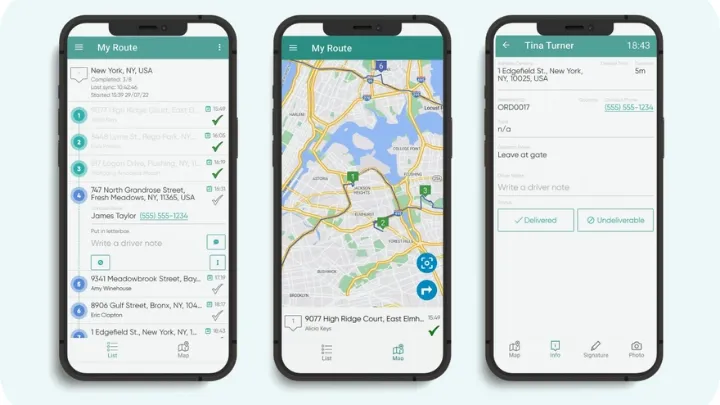
You should be able to re-optimize the route at the click of a button and have the updated route appear on the driver app. You should also be able to update dispatch notes to tell a driver to leave the package with a neighbor instead, or to have the driver capture e-signature proof of delivery instead of photo proof. SmartRoutes sends push notifications directly to the driver app with real-time route updates.
A clean mobile interface
Drivers need a super-simple app interface to do their job. The app needs to tell them what to do next and allow them to gather information quickly and simply when out on the delivery route. Intuitive next steps and accurate data capture will be the difference between drivers using the app and drivers pushing back on it.
Customer communications
The mobile app is a tool for drivers but it is also a live beacon telling dispatch and customers exactly where the package is. These SMS notifications update customers with an up-to-date estimated time of delivery.
Customers can be sent an automated SMS that is geo-fenced to when a driver is within 30 minutes of the delivery location. the SMS also contains a live tracking link which customers can click on and then access a live map of the delivery vehicle so they can see where it is, where they are in a queue of deliveries and when exactly it will arrive.
What are the Benefits of Package Delivery Apps?
- Maintain sequence of parcel deliveries: Some businesses need the route to be calculated in a certain sequence, for example, if you want to deliver in certain time windows that were booked by the client. In this instance, early deliveries can be just as bad as late therefore a sequence can be added.
- Re-optimize for same-day delivery commitments: Re-optimize routes based on changed circumstances or slot in last-minute orders to fulfill a same-day delivery commitment. Re-optimization can be done by either the driver on the mobile app or by the dispatch team on the delivery management software dashboard.
- Driver updates: Drivers can receive updates from dispatch through the dispatch notes feature, giving them the information they need to get each package delivered correctly. They can also add their own notes in the app for future runs, such as access codes or where to leave a package if the recipient is not home.
- Manage zones: Delivery teams can easily assign zones to drivers using a package delivery app. Zones assigned to a driver mean that any stops outside of this area cannot be assigned to the driver. This helps delivery teams divide up geographies, keep the workload fair, and avoid drivers or adjacent depots overlapping in their deliveries. This can also allow delivery vehicles to be packed more efficiently from the depot.
- Stagger pickup times: Using a package delivery app means you can stagger when drivers pick up their loads and avoid congestion at the depot and streamline things. Pickers get orders ready and have drivers ready to load in order. Staggered pickups and drop-offs avoid unnecessary delays.
- Coordinate complex orders: Order management including multiple packages per stop can be itemized and docketed using the package delivery system. Order slips can be printed and attached to each order so the driver knows exactly what to leave. Order management is essential for most businesses and will avoid missed items and the need to return to customers.
- See Delivery on time stats: Delivery on-time reports highlight the overall efficiency of a delivery team or individual driver. They show the number of stops that were delivered within the time window set and are a key indicator of delivery performance that can be tracked.
SmartRoutes Route Planning Software
Streamline your entire delivery process, all from one platform

5 of the Best Package Delivery Apps
Here are five package delivery apps that cover different team sizes, budgets, and use cases, from small courier outfits to large delivery operations.
1. SmartRoutes
SmartRoutes is built for delivery teams that need to plan multi-stop routes, keep drivers on schedule, and give customers accurate delivery updates without adding extra admin work.
It connects planning, driver activity, and customer communication so dispatchers can see what is happening on every route in real time.
For teams running anything from a handful of vans to a larger fleet, SmartRoutes helps turn daily drops into clear runs that are easy for drivers to follow and simple for managers to review afterward.
Key Features:
- Automated Route Planning: SmartRoutes automates route creation based on various factors like driver capabilities, vehicle types, and delivery priorities.
- Real-Time Updates: Provides live package tracking and updates, ensuring drivers and customers have accurate information throughout the delivery process.
- Customer Notifications: Sends automated notifications to customers, keeping them informed about their delivery status and estimated arrival times.
- Delivery Performance Tracking: Monitors delivery performance metrics such as on-time deliveries and efficiency improvements over time.
Pricing: Starts at $29 per month, making it affordable for businesses of all sizes to implement advanced route planning and tracking capabilities.
Why Choose It?: Its strong set of features and user-friendly interface make SmartRoutes an ideal choice for businesses looking to run delivery operations in a more organized way, improve customer satisfaction, and reduce wasted time and distance on routes.
2. Spoke (formerly Circuit)
Spoke focuses on helping drivers and courier teams turn long lists of stops into clear routes they can complete within the day.
It started as a tool for individual drivers and has grown into a platform that can also support teams that need shared visibility of routes and proof of delivery.
This makes it a useful option for couriers who want a simple mobile app for day-to-day work, with the option to add dispatch features as their operation grows.
Key Features:
- Basic and Advanced Route Planning: Offers basic route planning features for individual drivers and advanced functionalities like Proof of Delivery (POD) and fleet tracking for teams.
- Scalability: Scales well from individual users to larger teams, providing flexibility as businesses grow.
- Cost-Effective Options: Individual package delivery driver app price starts at $20 per month, with Spoke Dispatch (formerly Circuit for Teams) available from $100 per month, catering to various budget and operational needs.
Pricing: Spoke provides cost-effective pricing tiers that cater to different business sizes and requirements, ensuring scalability without compromising functionality.
Why Choose It?: It’s a popular choice due to its scalable solutions and full set of features that improve efficiency and tracking capabilities across diverse delivery operations.
3. Locus
Locus is aimed at larger organizations that run complex delivery networks and need software to handle high volumes of orders with minimal manual planning.
It uses data and algorithms to decide how orders should be grouped, which vehicles should handle them, and how routes should be sequenced. This focus on large-scale planning makes Locus suitable for enterprises where small changes in routes and fleet allocation can have a big impact on cost, service levels, and driver workload.
Key Features:
- Advanced Route Planning: Uses deep machine learning algorithms for precise route optimization, adapting dynamically to changing variables.
- Automation: Automates complex logistics tasks, reducing manual effort and increasing operational efficiency.
- Scalability and Consistency: Provides consistent transport planning across large-scale operations, ideal for enterprises with extensive delivery networks.
Pricing: Starting at $10,000 per year, Locus offers a high-end solution tailored for large enterprises requiring sophisticated logistics management and scalability.
Why Choose It?: Ideal for enterprises needing a highly automated and scalable solution that integrates advanced technology to optimize delivery processes and ensure consistency.
4. OptimoRoute
OptimoRoute is designed for businesses that want a single tool to plan routes, assign work to drivers, and review how each round performed afterward.
It is widely used by courier services and field-based teams who visit multiple stops each day and need clear daily plans they can send straight to driver devices.
With support for different business rules, time windows, and service types, OptimoRoute helps smaller and mid-sized operators keep routes realistic while still making good use of their vehicles and drivers.
Key Features:
- Automated Route Planning: Efficiently plans routes based on multiple variables, optimizing for time and cost effectiveness.
- Real-Time Updates: Provides live updates and alerts to drivers and dispatchers, ensuring they can respond to changing conditions promptly.
- Extensive Reporting Tools: Offers detailed reports on delivery performance and operational metrics, aiding in continuous improvement.
Pricing: Starts at $39 per month, making it accessible for small to medium-sized businesses seeking reliable route planning and management capabilities.
Why Choose It?: Its global usage and feature-rich platform make OptimoRoute a reliable choice for businesses looking to run delivery operations in a more organized way and enhance customer satisfaction through efficient route planning and management.
5. Zeo Route Planner
Zeo Route Planner serves drivers and dispatchers who need a straightforward way to arrange stops in the right order and monitor progress as the day unfolds.
It is often adopted by smaller courier outfits and independent drivers who want more control than basic navigation tools can offer, without the complexity of a full enterprise system.
By focusing on easy route setup, quick changes, and clear status information, Zeo helps users keep deliveries on track and adjust plans when new jobs or delays appear during the day.
Key Features:
- Route Optimization: Utilizes advanced algorithms to optimize routes for efficiency and cost-effectiveness.
- Real-Time Tracking: Provides real-time tracking capabilities, allowing stakeholders to monitor delivery progress accurately.
- Customer Notifications: Sends automated notifications to customers, keeping them informed about their delivery status and estimated arrival times.
Pricing: Starts at €34.99 per month, offering a balance of functionality and affordability for various user types.
Why Choose It?: Zeo Route Planner is preferred for its user-friendly interface and wide range of features that cater to the needs of drivers and logistics managers alike, helping teams keep routes organized and deliveries on schedule.
Choosing the Right Package Delivery App for Your Business
Choosing a package delivery app is mainly about matching the tool to how your team works day to day. Smaller operations might value a quick way to build routes and send simple driver instructions, while larger fleets need stronger controls around planning, reporting, and customer updates.
The five apps in this guide cover a range of needs, from in‑house drivers to outsourced delivery partners, so you can pick the option that fits your routes, volumes, and service promises. If you want to see how route planning, driver tracking, and customer notifications can work together in one place, you can start with a 7 day free trial of SmartRoutes and test it on a real round.
Frequently Asked Questions About Package Delivery Apps
1. What are the key features to look for in package delivery apps?
Key features to look for when you are choosing a package delivery app include:
- Automated route planning: The app should build routes automatically based on driver availability, vehicle capacity, traffic, and delivery time windows.
- Real-time tracking: Dispatchers and customers should be able to see where drivers are, get accurate arrival times, and follow progress through the day.
- Customer notifications: The app should send automatic updates about delivery status, estimated arrival times, and delivery confirmation.
- Analytics and reporting: Good apps include reports on on-time deliveries, average delivery times, and driver performance so you can spot issues and improve future routes.
2. How can package delivery apps for drivers improve delivery efficiency?
Package delivery apps help drivers complete their work more quickly and with fewer mistakes by:
- Optimizing routes: Automatic route planning cuts out unnecessary distance, reduces fuel use, and helps drivers complete more stops in a day.
- Providing real-time updates: Live information on each route lets dispatchers spot delays early and adjust plans, so drivers can stay on track.
- Improving communication: In-app messages and status updates reduce back-and-forth calls and make it clear to everyone what is happening with each delivery.
3. Can package delivery apps integrate with existing ordering or inventory systems?
Yes, many package delivery apps connect with existing ordering or inventory systems so you do not have to move data by hand. Integrations can:
- Receive delivery orders: The app can pull new orders straight from the ordering system, which cuts down on manual entry and reduces errors.
- Sync delivery status: Status updates from the delivery app can be sent back to the ordering or inventory system so both show the same, up-to-date information.
- Reduce admin work: Automatic data sharing between systems cuts paperwork, saves time for office staff, and makes it easier to keep delivery records accurate.
If you liked this blog you may also be interested in:
 Caroline Hassett