
Quick Summary
- Sending live, dynamic ETAs based on GPS and traffic data can cut “where is my order?” queries and support much higher first attempt delivery rates.
- Pairing estimated time of arrival with a clear delivery time window makes it easier for customers to plan their day and reduces missed deliveries at the door.
- Treating ETA as a continuous calculation, not a one‑off promise, lets you adjust arrival times in real time when routes change or drivers are delayed.
- Using probabilistic ETAs (time windows with confidence levels) works better than fixed times for long or unpredictable routes, where a single “best guess” often misleads customers.
- Accurate ETAs and ETDs do more than inform customers; they increase delivery efficiency by cutting wasted waiting time, repeat runs, and support workload.
What Is Estimated Time of Arrival (ETA)?
"What's the ETA on that?" Let’s face it, none of us especially like waiting for things. But knowing the estimated time of arrival for something can make the experience a whole lot better.
That’s why communicating your plans to your paying customers matters so much. By accurately estimating the time of arrival or delivery, you can give your business, your employees, and your customers an easier life and a better experience. Delivery route planning, in fact, is built on being able to accurately predict and communicate ETDs to customers.
We take you through the in’s and out’s of ETAs and ETDs below and provide useful hints and tips to get your own solution in place.
When we talk about estimated time of arrival, we refer to the time and date that a shipment is expected to arrive at a particular destination. Although the specific location can vary from case to case, it is generally a seaport or airport. However, the most common place you will hear an ETA referred to is when a passenger plane is expected to land at an airport.
This is the easiest way to remember that ETA refers to the airports and seaports. In the vast majority of cases, the shipping method will be via air, sea or domestic shipping services such as rail or road.
ETA vs ETD: Key Differences
As outlined above, the key difference between estimated time of arrival (ETA) and estimated time of delivery (ETD) is that ETAs refer to the arrival of a consignment at a seaport or airport, while ETDs refer to the delivery of a consignment at its final destination (with the end customer).
ETAs are usually fixed, while ETDs can be more flexible and updated.
SmartRoutes Route Planning Software
Streamline your entire delivery process, all from one platform

How Is Estimated Time of Arrival Calculated?
At its simplest, estimated time of arrival is based on how long it should take a vehicle to cover the remaining distance to its destination at a typical speed. In other words, you estimate how long the journey will take, then add that to the departure time to get an arrival time window.
A simple way to think about it is:
- Start with the distance between the current location and the destination.
- Use an average speed that is realistic for that route and vehicle.
- Add time for loading, unloading, breaks, and likely delays such as traffic or weather.
In basic terms, the calculation looks like this:
- Travel time = remaining distance ÷ average speed
- ETA = departure time + travel time (plus any planned handling times and a small buffer)
For example, if a driver leaves a depot at 9:00, has 100 km left to travel, and you expect an average of 50 km/h, the travel time is around two hours. If you add 30 minutes for unloading at the customer’s address, you get an ETA of around 11:30. This is how many teams still calculate ETA by hand or in spreadsheets.
Types of ETA: Fixed, Dynamic, and Real-Time
Not all ETAs are the same. In practice, most operations use a mix of fixed, dynamic, and probabilistic ETAs, depending on the predictability of their routes and the amount of data available.
Fixed ETA
A fixed ETA is a single arrival time or time window that you share once and rarely change. For example, a delivery promise like “arrives Tuesday between 9:00 and 11:00” that stays the same, even if the driver hits traffic.
- Works best on very predictable routes
- Simple to explain to customers and easy for planners to work with
- Can cause frustration when conditions change and the driver is clearly running late but the ETA has not been updated
Dynamic ETA
A dynamic ETA updates as conditions change. The system looks at live GPS data, traffic, route changes, and delays, then recalculates the arrival time during the trip.
- Ideal for last mile delivery, same‑day services, and dense urban routes where traffic is unpredictable.
- Gives customers a more accurate live view of when the driver will arrive, often via tracking links or automated notifications.
- Helps planners spot issues early, such as a driver falling behind on a route, and make adjustments in real time.
Probabilistic ETA
A probabilistic ETA describes an arrival window along with a confidence level. Instead of saying “10:30,” you might say “arrives likely between 10:15 and 10:45”.
- Useful for longer, less predictable journeys, such as multi‑day routes.
- Acknowledges that there is uncertainty in the plan and gives operations teams more realistic expectations.
How to Communicate ETD to Customers
For readers of the SmartRoutes blog, it’s likely that you’re more interested in the last mile of delivery as opposed to the first mile. For that reason, we’ll take a look at how you can notify your customers of the estimated time of delivery for goods delivered by road in the last mile.
There are 3 key ways of communicating ETD’s to your customers
1. Phone Call
Once your route planning has been done and you have estimated the time you will serve each drop, you may opt to call the customer to inform them of the time you plan to make the delivery.
It’s a straightforward way of advising your customers of delivery, but it is manual and labor-intensive.
Certainly not the best way, but it may work if your volume of deliveries is small and customers are repeat and known to you.
2. Email
Emailing your customer with the planned ETD for their package can be effective. Emails are free, and can be automated through a delivery management software system. The added benefit over a phone call is that they do not take any additional time of you or your staff, and it can also serve as proof that you informed the customer of the planned ETD beforehand.
3. SMS
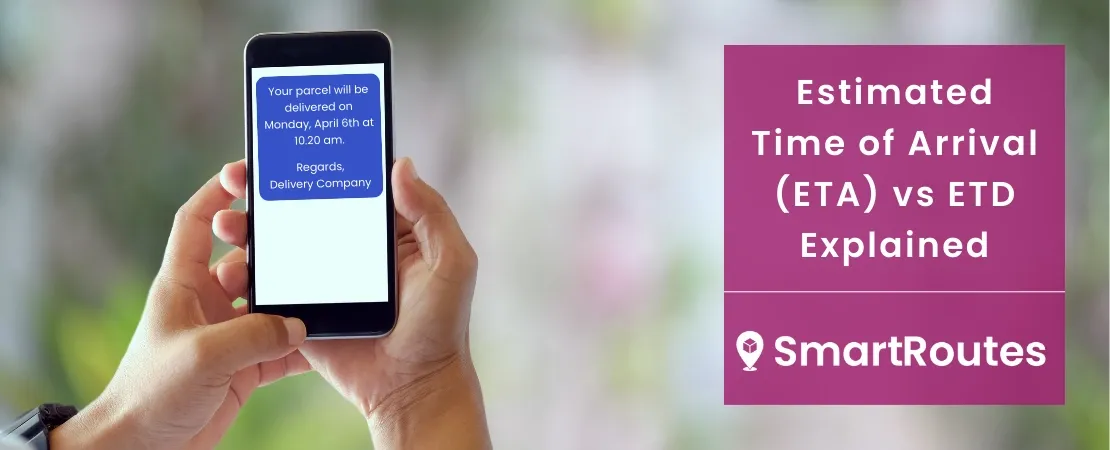
SMS messages can be a great way of informing your customers of the planned ETD for their deliveries and especially if it is a contactless delivery.
Almost everyone now carries a phone of some sort in their pocket, and instant notification via a SMS message can be the most effective way of ensuring they are prepared to receive the delivery.
When a parcel moves to an out for delivery status, that kind of timely update helps customers understand that their order is on the vehicle and due to arrive soon, rather than waiting without any clear information.
It has the slight advantage over email, as it is instant and less likely to be missed by the consignee.
At SmartRoutes, we have analyzed the data and we have found that clients who use personalized, automated SMS notifications vastly improve first-time delivery rates.
Although they can have a nominal cost compared to free emails, they can make a clear difference to the delivery experience your business provides. As companies like Amazon and UPS raise expectations on delivery, this can be a simple way for your business to stay competitive on service levels.

Benefits of Sharing Accurate ETA and ETD with Customers
Great customer service
That delivery experience is central for businesses that want their delivery service to work well. Without happy customers, the long‑term outlook for any business will not be a good one.
Getting customers ready for the arrival of their purchase and delivering it as promised leaves them satisfied and more likely to become a repeat customer and refer you to a friend.
Setting clear expectations around estimated time of arrival and delivery windows is one of the most direct ways to avoid disappointment and keep customers confident about your service.
Giving them an ETD in advance shows that you care about their time.
Smooth and efficient operation of your business
Giving your customer a forecast of when their order will arrive is actually as important to you as it is to them.
By providing consignees with accurate ETD in advance, it gives them a chance to make themselves available to receive the goods. This means that deliveries aren’t missed, drivers do not waste time waiting around for someone that isn’t there, and you save on the cost of re‑routing the delivery on another run. Offering customers a clear delivery time window on top of an ETA goes a step further by letting them plan their day around the delivery.
This becomes even more important for higher value or service‑heavy drops, where white glove delivery requires customers to be available for unpacking, placement, or installation.
This results in happier drivers and customers too, which eliminates time spent dealing with issues that shouldn’t exist.
How SmartRoutes Helps You Manage Estimated Time of Arrival
Getting estimated time of arrival right is hard to do manually. Routes change, drivers hit traffic, and customers expect accurate updates, not rough guesses. SmartRoutes brings all of this together in one delivery management platform so you can plan efficient routes, generate realistic ETAs, and keep customers informed without extra work for your team.
Once you upload your orders, SmartRoutes optimizes routes and assigns an estimated time of delivery to every stop on the route. These ETAs are then shared automatically with customers by SMS or email, using templates you control. As drivers move through their day, live GPS tracking and a real‑time dashboard update ETAs in the background, so your team can see where every driver is and how each route is progressing.
For your customers, this looks like clear delivery notifications and a live tracking link that shows where their order is and when it is likely to arrive. For your support team, it means fewer “where is my order?” calls and more time spent on work that moves the business forward. If you want to see how this could work for your own delivery operation, you can start a 7day free trial of SmartRoutes today and test live ETAs on your next routes.
FAQ
1. What is ETA (Estimated Time of Arrival) in shipping terms?
ETA, or Estimated Time of Arrival, is a crucial logistics term referring to the predicted time when a shipment, vehicle, or cargo is expected to reach its destination or a specific checkpoint within a transportation route. It's calculated based on various factors such as distance, speed, route conditions, and potential delays. ETA provides valuable information to stakeholders involved in logistics, allowing them to plan, track, and coordinate shipments efficiently.
2. What is ETD (Estimated Time of Delivery) in logistics?
ETD, or Estimated Time of Delivery, is another vital logistics concept. It represents the anticipated time when a shipment will be delivered to its final destination, typically to the recipient or consignee. ETD considers factors beyond transportation time, including processing at distribution centers, customs clearance (for international shipments), and any additional handling required. It helps logistics professionals and customers prepare for the arrival of goods.
3. Why is knowing the difference between ETA and ETD important for supply chain management?
Distinguishing between ETA and ETD is crucial in supply chain management because it affects planning and decision-making. ETA focuses on when a shipment will arrive at specific points along its route, enabling efficient scheduling of resources and reducing idle time. ETD, on the other hand, provides insights into when the final delivery will occur, allowing recipients to prepare for the receipt of goods. Accurate ETA and ETD predictions help minimize inventory costs, reduce delays, improve customer service, and enhance overall supply chain efficiency.
4. What are some common challenges in achieving accurate ETA and ETD predictions?
Achieving precise ETA and ETD predictions can be challenging due to several factors: Unforeseen traffic congestion, accidents, and adverse weather conditions can disrupt schedules. Inaccurate data sources or outdated information can lead to incorrect predictions. Multi-modal transportation involving various carriers can introduce complexities in coordination. For international shipments, delays during customs clearance and border crossings are common challenges. Mechanical failures or technical issues with vehicles can impact timelines.
If you enjoyed this blog, you might also be interested in:
 Caroline Hassett
 Caroline Hassett