
Quick Summary
- On time delivery (OTD) is the share of orders that arrive on or before the promised time window, calculated as on time deliveries ÷ total deliveries × 100.
- The biggest levers for improving OTD are smarter route planning, realistic delivery time windows, clear delivery notifications, and well supported drivers.
- Late deliveries usually stem from weak daily planning, disorganized warehouses, under staffed or poorly trained teams, and external issues like traffic or site delays.
- Tracking a small set of delivery KPIs such as order lead time, fulfillment time, transportation time, and order accuracy makes it easier to pinpoint where delays start and what to fix first.
On time delivery (OTD) is the percentage of orders that arrive when you promised, and it is one of the key KPIs for last mile and parcel delivery teams. It plays a major role in the overall delivery experience, from how reliable your brand feels to whether customers choose to order from you again.
When deliveries run late, you do not just frustrate customers; you also create extra support tickets, throw off the rest of the route, and make it harder for your team to stay organized. In this guide, we will cover how to calculate your on time delivery rate, the most common reasons it slips, and practical ways to improve it across your operation.
Calculating the On Time Delivery Rate
Calculating your on time delivery rate is straightforward. At a basic level, it is the percentage of deliveries that arrive on or before the promised time window within a given period.
On time delivery rate (%) = (Number of on time deliveries ÷ Total deliveries) × 100
For example:
- A courier company completed 1,000 deliveries in a week.
- 50 of those deliveries arrived after the promised time window.
The number of on time deliveries is 950, so the on time delivery rate is:
(950 ÷ 1,000) × 100 = 95%
SmartRoutes Route Planning Software
Streamline your entire delivery process, all from one platform

7 Tips on How to Improve On Time Delivery
Implement a unified delivery operations hub
A single source of truth for your delivery operations helps keep orders, routes, drivers, and customers aligned so nothing slips through the cracks on the day of delivery. Instead of juggling multiple tools or spreadsheets, centralizing route planning, driver manifests, customer details, and live tracking in one place makes it much easier to spot issues before they cause delays.
With everyone from warehouse staff to support and drivers working from the same real‑time information, you reduce misloads, avoid missed instructions, and protect your on-time delivery rate.
Provide full visibility and oversight to your team
Warehouse staff, drivers, customer support, and customers all need access to clear information about what is happening on the day of delivery.
Keeping teams in the dark about routes, delivery times, or order status leads to confusion, long calls, and missed drops.
If customer service can see where a driver is and what is on the van, they can give clear updates and help customers plan to be available.
If drivers can see accurate order details on their device, including notes like access codes or the correct entrance, they can complete stops faster and avoid failed deliveries that damage your on time delivery rate.
Use customer delivery notifications
Simple, but very effective in pushing your on time delivery rate closer to 100%.
Customer delivery notifications are one of the fastest ways to improve your on time delivery rate. If a customer does not know when you plan to deliver, they cannot plan to be available or make small changes that would help the driver.
Delivery notifications send an SMS or email with an approximate delivery time based on the route schedule from your delivery management system. That means no extra manual work for you or your team.
With a quick message and an accurate time window, customers can adjust their plans or leave clear instructions, which reduces missed deliveries and complaints and makes the delivery journey smoother for everyone.
Optimize delivery routes
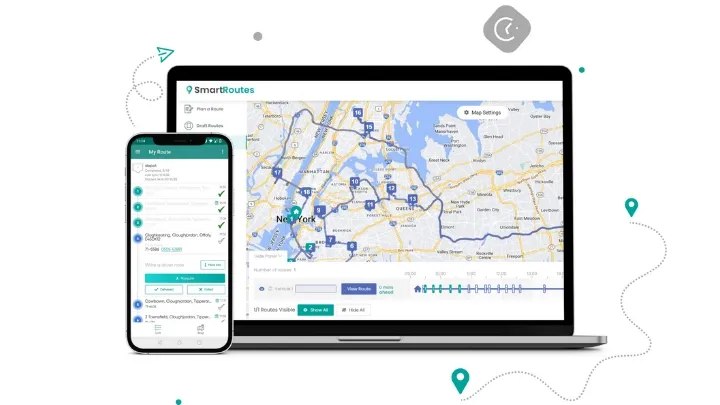
Route optimization has been central to how SmartRoutes helps delivery teams reduce wasted miles and hit tighter delivery windows.
By using software to build efficient routes, you cut drive time, reduce fuel costs, and give drivers a realistic schedule for the day.
Route optimization software is one of the most reliable ways to improve on time delivery, because it helps drivers follow the best sequence of stops and stay within the promised delivery window.
Motivate and reward delivery drivers
In a delivery business, drivers are often the only people your customers meet in person, so the way they work and communicate has a direct impact on your reputation.
They handle driving, customer questions, and problem solving at the door, and they often carry the weight of your brand in every interaction.
Paying drivers a fair wage and giving them clear routes and tools is a simple way to increase both customer satisfaction and staff retention.
It is worth investing in comfortable uniforms and safe footwear, but also in a driver app that includes navigation, full delivery details (address, customer phone number, any notes), and status updates.
With this in place, your support team can handle most customer questions without calling drivers, which keeps drivers focused on the road and helps them stay on schedule.
Use durable packaging labels
This is another simple change that is often overlooked. According to research by ParcelLab and YouGov, in the UK, 9 million people have received damaged parcels at some point. With more and more people shopping online, that figure is a clear warning for delivery businesses that want to grow.
Avoiding damaged goods should be a primary concern. If drivers do not have to spend time explaining damage or waiting while customers check items at the door, they are more likely to stay on time for the rest of the route.
There are many providers of durable packaging materials, but it is worth looking at an industry leader like Avery to see what you could be using.
Plan realistic capacity and delivery time windows
Overpromising on delivery slots is one of the fastest ways to damage on time performance, even if your routes and drivers are performing well.
Start by basing daily capacity and time windows on real data: typical stop duration, loading times, traffic patterns, and average dwell time at the door.
When your promised windows reflect what your team can reliably achieve, you avoid overloaded runs, constant knock-on delays, and last-minute cancellations that drag down your on time delivery rate.
Main Causes of Poor On-Time Delivery Performance
There’s no single reason for late delivery, but it can be a combination of factors that lead to a business.
Lack of delivery planning processes
If you do not plan your delivery operation carefully, late deliveries are almost guaranteed.
Many delivery operations still lack a clear, repeatable process. If there is no system for creating driver manifests and getting vehicles loaded in the morning, you introduce delays before the vans even leave the yard.
If there is no agreed route for drivers to follow, they can waste time on inefficient routes they think are best. If loading and return-to-depot times are not staggered, the warehouse and yard quickly become congested.
If you run deliveries, you need a process that works, or your on time delivery rate will drop.
Poor warehouse & inventory management
Keeping your warehouse or depot organized and in control goes a long way towards keeping deliveries on track. It is also the first place to review if late deliveries are happening regularly.
Clear driver manifests, parcels grouped by delivery area, and loading bays organized by route all help reduce the risk to your on time delivery rate.
Poor warehouse and inventory management will almost always result in late deliveries.
Under staffing & poor training
We have already looked at the importance of drivers, but the same principle applies to everyone involved in the delivery process.
If warehouse, logistics, and support staff are engaged and trained, you will see the impact in more reliable delivery performance.
If people feel underpaid, under-resourced, or unsupported, mistakes increase and it becomes harder to meet delivery targets consistently.
External Factors
Some causes of late delivery are outside your control. Traffic, issues at the delivery site, and vehicle problems can all delay a run. There are many examples of this in any delivery business.
You cannot remove these risks completely, but you can allow some buffer in your planning, keep communication clear when delays happen, and focus on how quickly you recover when something goes wrong.
Hit Your On Time Delivery Targets with SmartRoutes
On time delivery requires all the moving parts of your delivery business to work together and for everyone to aim for the same clear objectives.
SmartRoutes helps you do this by giving you one place to manage route planning, driver dispatch, parcel status, and customer communication. The platform is designed to give every role in your delivery operation the visibility and tools they need to do their job well and keep deliveries on schedule.
You can try SmartRoutes for FREE over the next 7 days.
FAQ
1. What is on time delivery (OTD) in logistics?
On time delivery (OTD) is the percentage of orders that arrive on or before the promised time window. It matters because it directly affects customer satisfaction, repeat orders, and how reliable your delivery operation appears to customers.
2. How do I calculate my on time delivery rate?
To calculate your on time delivery rate, divide the number of deliveries that arrived on time by the total number of deliveries in a given period, then multiply by 100. This gives you a percentage that shows how reliably you hit your promised delivery times.
3. What are common causes of late or missed deliveries?
Late or missed deliveries often come from weak delivery planning, poor warehouse and inventory management, unrealistic capacity, traffic and site delays, or vehicle issues. Reducing these problems usually means tightening daily planning, improving warehouse processes, and giving drivers clear routes and order information.
4. Which KPIs should I track to improve on time delivery?
To improve on time delivery, track a small set of delivery KPIs: order lead time (from order to delivery), order fulfillment time (pick, pack, and ship), transportation time, and order accuracy. Reviewing these regularly helps you see where delays start and where to focus your improvements.
5. What strategies can I use to improve on time delivery?
Practical ways to improve on time delivery include optimizing routes, planning realistic capacity and delivery windows, sending delivery notifications, improving warehouse processes, and giving drivers clear tools and information. Many businesses also use delivery software to plan routes, track vehicles, and keep customers updated in real time.
6. What is a good on time delivery percentage?
Most delivery businesses aim for an on time delivery rate of at least 95%. In many sectors, anything in the 95–98% range is seen as strong performance, but the exact target depends on your industry, service promise, and customer expectations.
If you liked this blog you may also be interested in:
 Caroline Hassett
 Caroline Hassett