
Quick Summary
- A typical delivery van now burns about €28,200 in diesel per year, roughly €3,000 more per van than before the 2026 price spike.
- Manual route planning usually wastes 10–15% of fuel, and every percentage of that waste now costs more in real euros than it did at pre‑crisis prices.
- Musgrave’s 10‑store SuperValu fleet cut fuel per delivery by 12% and lifted delivery capacity by 15% after switching to SmartRoutes, while freeing 1–1.5 hours of planning time per store per day.
- For a 10‑van fleet today, a 12% fuel saving is worth roughly €33,840 a year and usually repays the cost of optimisation in well under two months.
- Waiting three months to act during a 12‑month period of elevated fuel prices leaves a 10‑van fleet with about €8,400 in avoidable fuel spend.
Diesel prices have jumped sharply in 2026. At the peak in late March, pump prices hit €2.30 per litre across Ireland. Even after the Government's emergency cuts, diesel is still sitting nearly 40 cents above where it was at the start of the year.
For fleet operators and delivery businesses, that difference shows up every week. It shows up at the pump, in the monthly accounts, and in conversations about whether certain routes are still worth running at all.
This article breaks down what the current price level is actually costing a typical Irish delivery fleet in hard numbers, why routing inefficiency makes the problem worse than it looks on paper, and what one Irish grocery operator did to cut their fuel spend by 12% per delivery.
If you run a fleet of any size, there is a number in here that applies directly to your operation.
What the Current Price Level Means for a Typical Fleet
The standard fuel consumption for an Irish delivery van sits at around 15,000 litres per year. At the current price of approximately €1.88 per litre, that's €28,200 in annual fuel per van at today's prices.
Compare that to the pre-crisis price of around €1.68 per litre, and you are looking at an extra €3,000 per van per year. That is the cost of nothing changing. Same routes, same stops, same drivers. Just more expensive fuel.
Scale it across a fleet and the numbers become very hard to ignore:
Operators who were pricing fuel at the March peak of €2.08 to €2.30 per litre are working with figures even higher than these. Irish hauliers reported additional costs of €1,000 per day at the height of the spike. The Government's emergency relief package helped, but it is subject to ongoing review and is not a permanent fix.
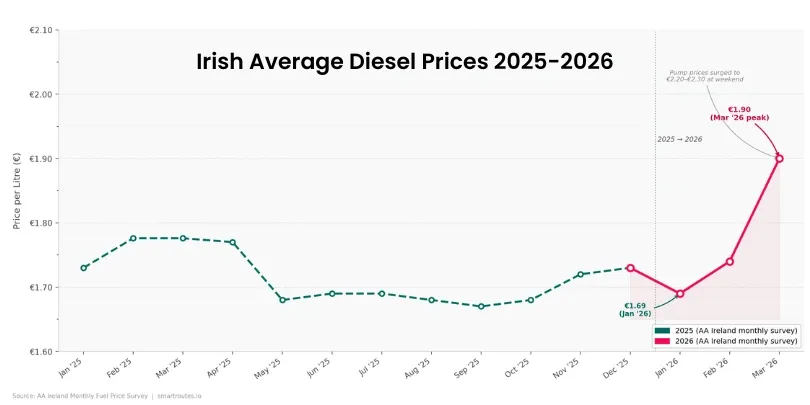
The IEA's assessment from February 2026 is that even in a best-case scenario, infrastructure damage from the Middle East conflict means elevated prices are expected to last at least 12 more months. That is the planning timeframe most operators are now working with.
SmartRoutes Route Planning Software
Streamline your entire delivery process, all from one platform

The Part That Doesn't Show Up on the Fuel Receipt
The extra cost per litre is visible. What is less visible is how much additional fuel many fleets are burning simply because of how their routes are planned.
Delivery fleets without route optimisation software routinely lose 10%-15% of their fuel spend to inefficiency. Extra kilometres from routes that are not properly sequenced, unnecessary backtracking, and manual planning decisions made under time pressure all add up. At €1.50 per litre, that inefficiency was a real cost. At €1.88 per litre, it is a significantly larger one, because the same percentage of waste now costs more in absolute terms.
A 12% saving on fuel for a 10-van fleet at pre-crisis prices would have been worth around €30,240 per year in fuel alone. At today's prices, the same 12% saving is worth €33,840. The inefficiency has not changed. The cost of fixing it has just become more compelling.
This is the part of the fuel crisis conversation that most fleet operators are not having yet. Rising prices have made the problem visible. But the real opportunity is in the proportion of that fuel spend that was always avoidable.
What Musgrave Did About It
Musgrave runs grocery home delivery across 10 Supervalu stores in Dublin, Limerick, Waterford, and Kilkenny. After switching to SmartRoutes, they recorded a 12% reduction in fuel per delivery, a 15% increase in delivery capacity, and savings of 1–1.5 hours per store per day in manual planning time. For a multi‑store operation, that planning time saving translates into more than 1,400 hours per year that can go back into improving delivery performance.
Those results held across four different Irish cities, including stores with rural catchment areas. That matters because Irish rural roads require geocoding accuracy that many routing platforms, built primarily for UK or European postcodes, cannot reliably deliver. SmartRoutes is built on Eircode-native routing, which means it handles Irish addresses accurately, including the rural routes that typically carry the highest fuel load per delivery stop.

What a 12% Saving Looks Like at Your Fleet Size
Take a simple example. A 10‑van fleet using the standard 15,000 litres per van per year baseline at the current price of €1.88 per litre spends about €282,000 per year on diesel. A 12% reduction in fuel per delivery, similar to what Musgrave achieved, works out at roughly €33,840 in fuel saved every year for that fleet size.
A saving of that size typically covers the cost of optimisation in well under two months. After that point, the savings flow straight to your margin.
The exact number for your operation will depend on your true annual litres per van and the routes you run. That is why the next step is to run your own number rather than rely on examples.
The Real Cost of Waiting
The most common response from fleet operators right now is to watch how the situation develops before committing to any new spend. That instinct is understandable, but it is worth running the numbers before deciding.
At a payback period of under two months, every month of delay is a month of unoptimised delivery efficiency with no corresponding saving. Three months of waiting costs a 10‑van fleet approximately €8,400 in avoidable spend.
FTA Ireland has called for additional targeted measures as the crisis deepens, signalling that the industry does not expect a quick return to pre-crisis pricing. The IEA's 12-month forecast reinforces that position. Waiting for prices to normalise before acting is a strategy, but it is an expensive one.
SmartRoutes can go live the same day. There is no multi-week onboarding project, no lengthy setup period, and no delay while the fuel bill continues unchecked. Operators who start this week will have recovered the full software cost before the end of June.
Start Recovering the Cost This Week
Irish diesel remains well above the levels operators had built into their plans at the start of the year, and the IEA expects elevated prices to persist for at least the next 12 months. That means every month you run the same routes with the same fuel consumption is a month where avoidable costs stay in your P&L.
Musgrave has already shown what a 12% reduction in fuel per delivery can look like in an Irish grocery operation. The same underlying mechanics apply whether you run three vans or thirty: better routing, fewer wasted kilometres, and less time spent rebuilding plans every morning.
If you want to see what that looks like for your own fleet, the next step is simple. Start your free trial and run your current routes through SmartRoutes for a few weeks. You will see very quickly whether the numbers justify making the change.
FAQ
1. How much is Irish diesel right now?
As of early April 2026, Irish diesel is typically between €1.88 and €1.95 per litre after the Government’s emergency cuts. That is down from peaks of around €2.30 per litre in late March, but still close to 40 cents higher than the level many fleets had built into their 2026 budgets.
2. How much can route optimisation realistically reduce fuel costs?
Musgrave’s result was a 12% reduction in fuel per delivery across 10 stores. That sits within the 10–20% range often reported when fleets move away from manual or spreadsheet-based planning. The exact figure for your fleet will depend on how manual your current process is, how dense your routes are, and how often plans change at short notice.
3. How quickly does SmartRoutes usually pay for itself?
Using the Musgrave 12% saving and the standard 15,000 litres per van per year baseline at around €1.88 per litre, most fleets see the software cover its own cost in well under two months. For a 10‑van fleet, the saving over a single quarter is clearly visible in fuel spend alone, before you factor in saved planning time.
4. Does route optimisation still help on Irish rural routes?
Yes. Rural routes often see some of the largest gains, because a few unnecessary kilometres per stop add up quickly when drops are far apart. SmartRoutes uses Eircode-native geocoding, so it can place Irish rural addresses accurately and sequence them in a way that avoids the backtracking and missed turns that drive up fuel use on non‑urban runs.
If you enjoyed this blog, you might also be interested in:
 Caroline Hassett
 Caroline Hassett