

Quick Summary
- Manual routing starts to break down when delivery volumes exceed 500 drops per month, creating mid-day replans, hidden overtime, and operational fragility.
- Last mile furniture delivery is high-stakes: two-person crews, fixed delivery windows, and white-glove service magnify even small inefficiencies.
- Hidden overtime quietly increases labour costs, often going unnoticed until payroll is reviewed.
- Rising customer enquiries about delivery timing signal operational stress, not just service issues.
- Many teams rely heavily on one or two planners or managers, creating fragile knowledge and double work when key people are unavailable.
- Even small inefficiencies have a real financial impact, with white-glove deliveries costing €60–€150 each.
- Benchmarking your operation using industry averages can reveal where time, staff effort, and budget are being lost, helping teams work smarter and reduce reliance on ad-hoc processes.
Furniture delivery isn’t like other last-mile operations.
Every delivery is high-stakes, and there’s very little margin for error.
For many mid-market furniture retailers in the UK and Ireland, delivery volumes now hit 2,000–5,000 drops a month. At that scale, the old ways of planning routes, spreadsheets, sticky notes, and gut instinct start to break down.
The result? Midday replans, hidden overtime, rising customer queries, and teams that rely on one or two people to keep everything running.
The Tipping Point
Under a few hundred deliveries a month, manual planning usually works.
A planner knows the drivers. Routes fit neatly on a screen and exceptions are handled with little to no problems.
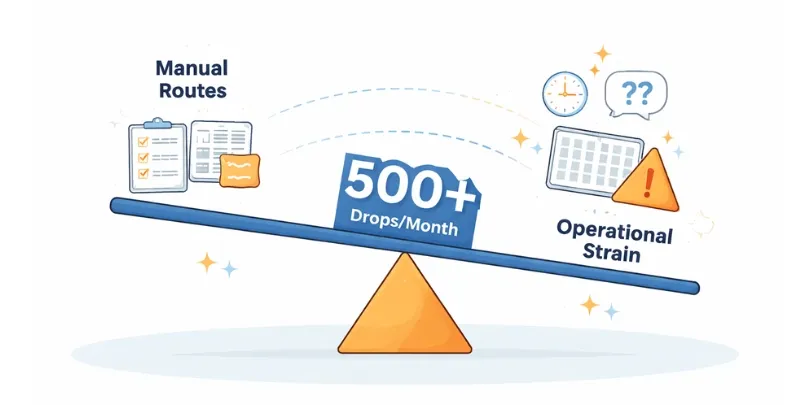
However, once monthly volumes exceed 500 drops, everything starts to feel different. Routes that looked fine in the morning can require multiple adjustments by midday. And by the time a business reaches 2,000–5,000 deliveries per month, the cracks are no longer subtle.
Manual processes simply cannot keep up with the scale and complexity at this point.
Mid-day route rebuilds become normal
In theory, routes are planned once at the start of the day and everyone follows the plan until the last delivery.
In practice, this almost never happens.
New orders get added, collections are slotted in late, and items sometimes fail to arrive on time, forcing planners to rethink what they thought was a finished schedule.
SmartRoutes Route Planning Software
Streamline your entire delivery process, all from one platform

As the day goes on, the original plan is often barely recognizable. Planners are juggling spreadsheets, whiteboards, and phone calls to keep drivers moving, while drivers wait for updated instructions.
This constant replanning isn’t a sign of poor teams or weak systems, it’s a natural consequence of operating in a dynamic, high-volume environment with two-person white-glove deliveries and fixed time windows. The impact is real: time is lost, decisions are made with partial information, and the flow of the day becomes reactive instead of planned.
Hidden overtime quietly erodes margins
On paper, routes often look perfectly timed. Drivers are scheduled to finish within their shifts, and planners tick off deliveries as if everything is under control. In reality, white-glove deliveries rarely follow the schedule exactly.
Long stop times, complex installs, and unexpected delays mean drivers often stay out well past their planned hours. During peak periods, it’s common for teams to work six-day weeks, stretching 60 to 70 hours. By the end of the week, these extra hours add up quietly, without anyone noticing until payroll is reviewed.
The problem is compounded because planning and payroll often live in separate systems. There is no immediate connection between route adjustments and labour costs, so overtime becomes invisible until it hits the bottom line. Furniture delivery software can help link planning, execution, and labour data to improve visibility, but many teams still rely on spreadsheets.
Rising customer enquiries reflect operational strain
During normal periods, retailers can expect around 10–25% of their queries to be about delivery timing or order location. During peak periods, that figure often rises sharply, sometimes pushing into the 15–40% range.
These spikes typically happen mid-afternoon, after initial delays or route changes have started to ripple through the day. Drivers may be running behind schedule, and planners are juggling adjustments while customer service teams haver to manage calls without real-time visibility.
Each ‘where is my order?’ call carries a real cost in agent time and internal follow-up. More importantly, the volume of enquiries highlights where planning is struggling to keep up with the reality on the ground. Addressing these operational triggers, rather than just treating the enquiries as isolated customer issues, is critical for controlling both cost and service quality.

When too much knowledge lives in too few heads
Many furniture delivery operations rely heavily on one or two experienced planners or managers to keep things running smoothly. These individuals know which routes can flex, which drivers can absorb extra work, and which customers require special handling.
The risk becomes obvious the moment someone is unavailable. Access to spreadsheets may be limited, multiple versions of the same plan can circulate, and colleagues often have to redo work to keep deliveries on track. This creates double work and a fragile system that can only operate at full capacity when key people are present.
When knowledge isn’t documented or shared effectively, teams spend more time reacting to problems than preventing them, and operational efficiency suffers, even in organisations with experienced staff.
Understanding the hidden costs and next steps
Understanding these patterns is the first step toward more predictable operations, better resource allocation, and less reliance on heroic effort from a few key people. It also helps retailers stay ahead of furniture industry trends, ensuring operations can scale efficiently as customer expectations and volumes grow.
Mid-day route changes, hidden overtime, rising customer enquiries, and knowledge concentrated in a few people are all predictable outcomes when delivery volumes scale beyond 500 drops a month.
Even small inefficiencies add up. With white-glove deliveries costing €60–€150 each, a few extra minutes per delivery, a missed window, or a reattempted drop can quietly erode margins and increase staff workload.
One of the easiest ways to see where these operational leaks are happening is to benchmark your own delivery operation. By comparing route stability, overtime exposure, and customer enquiry volumes against industry averages, you can identify where time and budget are being lost.
If you’re curious how your operation measures up, our benchmark page provides a clear view of common pressure points in furniture delivery and highlights opportunities for more predictable, efficient operations.
FAQ
1. Why do manual delivery routes start to break down beyond 500 drops per month?
At higher volumes, small disruptions, like new orders, missing items, or late collections, compound quickly. Planners spend more time adjusting routes mid-day, drivers wait for instructions, and customer service sees rising queries. Manual processes struggle to scale under these conditions.
2. How can I reduce hidden overtime in furniture deliveries?
Tracking route execution in real time and linking it to labour data helps uncover where drivers are working beyond planned hours. Implementing digital planning tools can make these inefficiencies visible before they impact margins.
3. How can I prepare my team for changes in furniture industry trends?
Understanding patterns in route instability, overtime, and customer enquiries helps teams adapt processes as furniture industry trends evolve. Digital tools and standardised workflows make scaling more predictable and efficient.
If you enjoyed this blog, you might also be interested in:
 Caroline Hassett
 Caroline Hassett